For many new divers, the first coral reef is unforgettable.
Suddenly, the underwater world isn’t just blue water. There are coral formations, colorful fish, sponges, sea fans and small creatures moving through a living landscape.
Cuba’s reefs offer divers the chance to experience this world at relatively shallow depths, including beginner-friendly sites around Varadero such as Playa Coral and Bacunayagua.
But what exactly is a coral reef?
How does it grow?
And why is it so important for divers to protect it?
This simple guide explains the basics so you can understand what you’re looking at the next time you descend onto a reef.
At a Glance
Question Simple Answer
What is coral? Coral is made up of tiny marine animals called polyps.
Are corals animals or plants? Animals.
What builds a reef? Many generations of coral organisms producing calcium carbonate skeletons.
What lives on reefs? Fish, invertebrates, sponges, algae and many other organisms.
Why are reefs important? They provide habitat and contribute to coastal protection and other ecosystem benefits.
Can beginners dive on coral reefs? Yes. Many reefs have shallow areas suitable for beginner experiences.
Biggest rule for divers? Maintain good buoyancy and avoid touching the reef.
What Is a Coral Reef?
A coral reef is a structure built over time by colonies of tiny animals called coral polyps.
Each polyp is a small animal related to sea anemones. Reef-building corals produce a hard skeleton made primarily of calcium carbonate. As generations of corals grow, die and leave their skeletons behind, the reef structure can become larger and more complex.
The result is something that looks like rock from above but is actually a living ecosystem.
And coral is not alone.
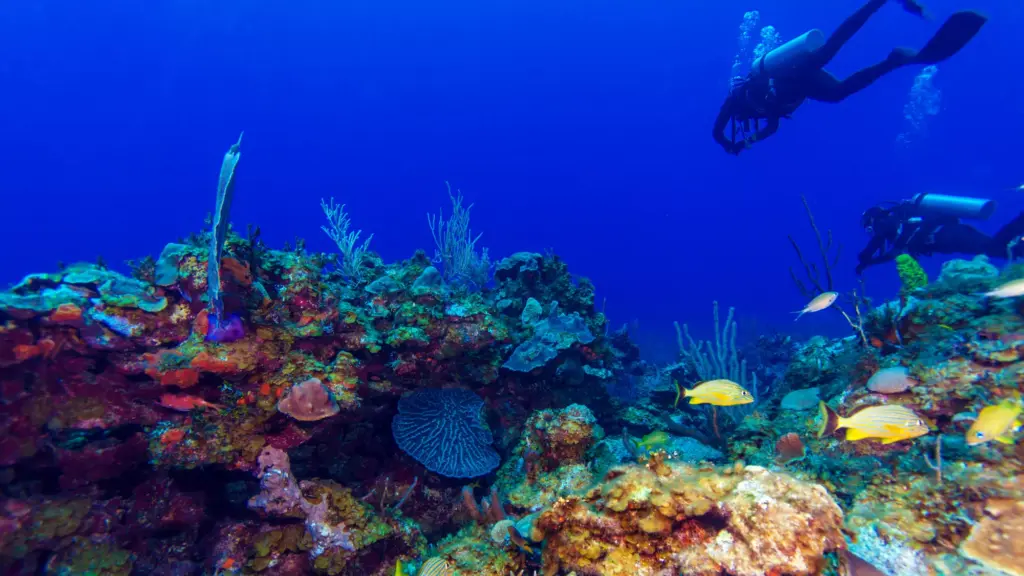
A healthy reef is home to many different organisms, including fish, crustaceans, mollusks, sponges, algae and other marine life.
That’s why a reef dive can feel like exploring an underwater city.
Corals Are Animals, Not Plants
This is one of the first things new divers often learn.
Although coral can look like colorful underwater plants, corals are animals.
A coral colony is made up of many individual polyps. Depending on the species, those polyps can form branching structures, rounded colonies, plates, ridges or other shapes.
Some corals also have a fascinating relationship with microscopic algae called zooxanthellae.
These microscopic algae live within coral tissues and use sunlight to produce energy through photosynthesis. The relationship provides an important source of energy for many reef-building corals and contributes to their characteristic colors.
This relationship is also important when understanding coral bleaching.
[Internal link: Coral Bleaching in Cuba: What Divers Need to Know]
How Do Coral Reefs Grow?
Reef growth happens gradually.
Individual coral polyps build their calcium carbonate skeletons. New polyps can grow on existing structures, while older coral skeletons remain part of the reef framework.
Over long periods, these layers can create the complex structures divers explore today.
This is one reason coral reefs deserve careful treatment.
A coral colony that looks like a small rock may actually represent years of growth and provide shelter for many other organisms.
Common Coral and Reef Organisms You May See in Cuba
Cuba’s reefs contain many different types of coral and other reef organisms.
As a beginner, you don’t need to memorize every species. Start by learning to recognize a few basic groups.
Hard Corals
Hard corals are among the main organisms responsible for creating the physical framework of many coral reefs.
They produce hard calcium carbonate skeletons that remain after individual polyps die.
You may see different forms including:
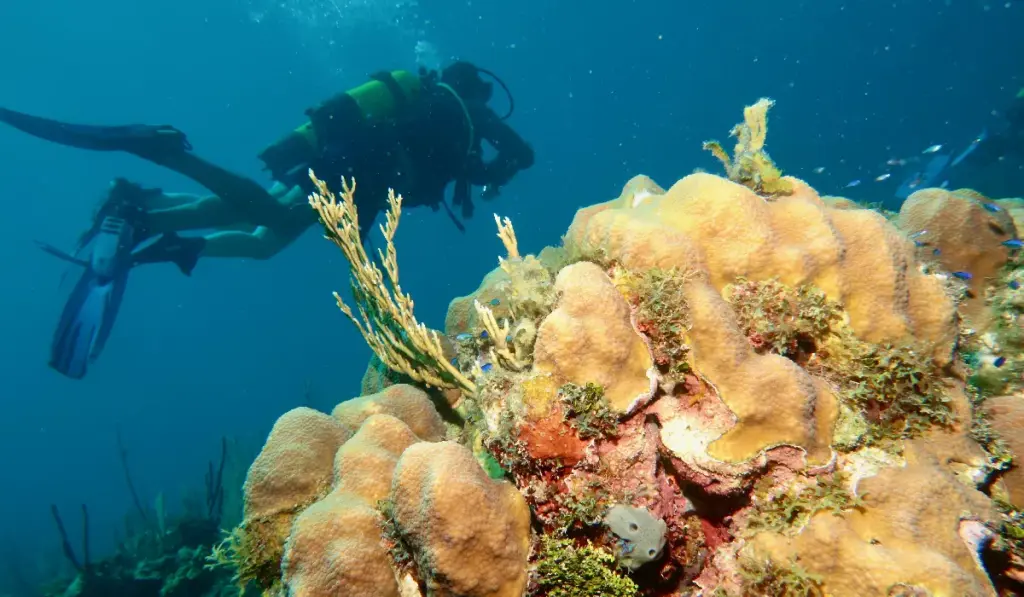
• Rounded brain corals
• Branching corals
• Boulder-shaped colonies
• Plate-like formations
• Other encrusting and massive corals
Look closely and you’ll often see that what appears to be a single piece of rock is actually covered with living coral polyps and other organisms.
Soft Corals
Soft corals don’t form the same rigid reef framework as hard corals.
Instead, many have flexible structures that move with the water.
Sea fans are a familiar example.
Their delicate branches can create beautiful underwater scenes, especially when small fish move among them.
They may look sturdy from a distance, but they are still living organisms and should never be touched.
Sponges
Sponges are not corals, but they are an important part of many reef communities.
They come in a huge variety of shapes, sizes and colors.
Some grow like tubes, others form large rounded structures, while others spread across the reef surface.
Once you start looking for them, you’ll realize that sponges are almost everywhere.
Algae
Algae are also an important part of reef ecosystems.
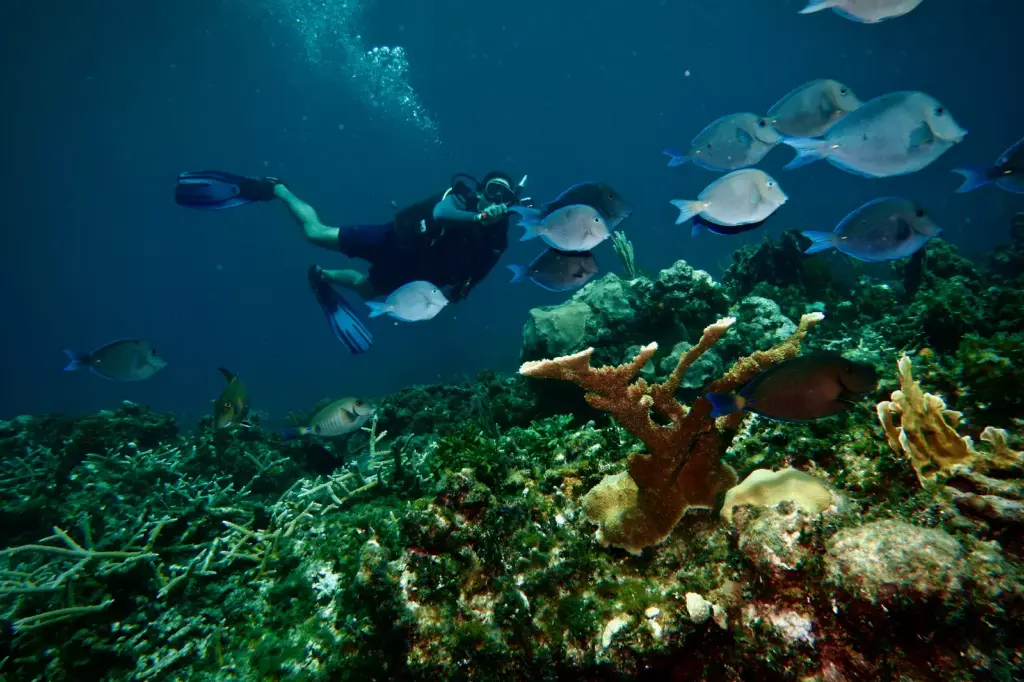
Some algae provide food for herbivorous fish such as parrotfish and surgeonfish.
A healthy reef has a balance between corals, algae and the many animals that interact with them.
Why Are Coral Reefs Important?
Coral reefs are important far beyond what divers see underwater.
They provide habitat for a huge variety of marine organisms and contribute to complex food webs.
They can also help reduce wave energy reaching coastlines, providing an important natural form of coastal protection.
For local communities, healthy marine ecosystems can also support activities connected with fishing, tourism and recreation.
For divers, there’s another reason they matter:
A healthy reef gives us somewhere extraordinary to explore.
Why Coral Reefs Are So Special for Divers
Imagine descending onto a reef and seeing:
A parrotfish scraping algae from the reef.
A school of grunts gathering beneath an overhang.
An angelfish moving between coral heads.
A trumpetfish almost disappearing against a sea fan.
A stingray crossing a sandy patch.
Suddenly, you’re not simply looking at coral.
You’re looking at an entire ecosystem interacting around you.
That’s what makes reef diving so rewarding.
[Internal link: Fish You’ll See When Diving in Varadero, Cuba]
You Don’t Have to Be an Advanced Diver to Appreciate a Reef
One of the best things about coral reefs around Varadero is that you can experience them without necessarily making deep dives.
Sites such as Playa Coral offer shallow reef environments that can be suitable for snorkeling, Discover Scuba experiences and certified divers.
[Internal link: Playa Coral Cuba: Snorkeling & Shore Diving Near Varadero]
Bacunayagua also begins in shallow water and offers different reef routes depending on experience, conditions and the planned dive.
[Internal link: Bacunayagua Diving Cuba: Coral Reefs, Marine Life & Cuba’s Highest Bridge]
For a beginner, this means you can concentrate on learning how to breathe, control your buoyancy and observe the reef without worrying about exploring deep water.
The Most Important Skill: Good Buoyancy
If you’re a new diver, one of the most valuable skills you can develop is good buoyancy control.
Your goal is to remain comfortably suspended in the water rather than constantly rising, sinking or using your fins to stay off the bottom.
Good buoyancy helps you:
• Avoid touching coral
• Reduce accidental fin contact
• Protect fragile organisms
• Move more calmly around marine life
• Use less energy
• Improve your underwater photography
It also makes diving more enjoyable.
Once you stop fighting your position in the water, you have much more time to look around and appreciate what’s happening on the reef.
Never Stand on Coral
This is one of the most important rules for new divers.
Coral is not a place to stand, sit, hold onto or push off from.
Even if a coral formation looks hard and rock-like, it may contain living organisms.
Contact can break delicate structures, damage coral tissue or disturb the organisms living around it.
If you need to stabilize yourself, ask your instructor or guide about appropriate techniques and equipment rather than grabbing the reef.
What About Your Fins?
Your fins can also accidentally damage a reef.
A large fin kick close to the bottom can:
• Break fragile coral
• Stir up sediment
• Reduce visibility
• Disturb small animals
• Damage organisms growing on the reef
Try to keep your fins behind and above the reef structure.
A calm, controlled kick is better than a large, powerful movement.
Don’t Collect Reef Souvenirs
A shell, piece of coral or unusual rock may look like a harmless souvenir.
But underwater, it can be part of an ecosystem.
That empty shell may become shelter for another animal. A piece of coral may provide habitat for tiny organisms. Removing objects from the reef changes the environment in small ways that can add up over time.
The best souvenir is the photograph.
Leave the reef where it belongs and take the memory with you.
What About Sunscreen?
Sun protection is important, especially in the Caribbean.
But whenever possible, reduce the amount of sunscreen that enters the water.
Practical options include:
• UV-protective clothing
• Rash guards
• Hats and shade while on the surface
• Avoiding unnecessary exposure during the strongest sun
• Choosing sunscreen carefully when you need it
The term “reef-safe” is not a guarantee that a sunscreen has no environmental impact, so don’t rely on the label alone.
The simplest approach is to combine physical sun protection with sensible sunscreen use.
[Internal link: Marine Life & Conservation in Cuba: A Diver’s Guide to Protecting Our Oceans]
Don’t Touch Marine Life
Coral isn’t the only thing you should avoid touching.
The same rule applies to fish, turtles, rays, lobsters and other marine animals.
Even an animal that appears curious may become stressed when divers repeatedly approach, chase or touch it.
Instead, slow down.
Watch.
Let the animal decide how close it wants to come.
This usually produces a better experience for both the diver and the animal.
Why Reefs Can Be Fragile
Coral reefs may look strong because they are made partly from hard skeletons.
But individual corals can be surprisingly vulnerable.
Physical contact, sediment, pollution, disease and unusually warm water can all place stress on reef ecosystems.
One major example is coral bleaching.
During stressful conditions, corals can lose or expel much of their symbiotic algae, causing them to become pale or white.
Bleaching does not automatically mean that the coral is dead. If stressful conditions improve, some corals can recover. However, prolonged or severe stress can cause coral mortality.
[Internal link: Coral Bleaching in Cuba: What Divers Need to Know]
What Can New Divers Do to Help?
You don’t need to become a marine biologist to be a responsible diver.
Start with a few simple habits.
Before the Dive
• Listen carefully to the dive briefing.
• Ask about the reef and local guidelines.
• Check that your equipment is secured.
• Make sure you understand the planned route.
• Tell your guide if you’re nervous or need help.
During the Dive
• Maintain good buoyancy.
• Keep your fins away from the reef.
• Never stand on coral.
• Don’t touch marine life.
• Don’t feed animals unless an activity is specifically designed and managed for it.
• Avoid collecting shells or other underwater objects.
• Keep your movements calm.
• Give wildlife space.
After the Dive
Think about what you saw.
Which fish did you recognize?
Which coral formations caught your attention?
Did you notice any animals hiding in the reef?
The more you learn about the ecosystem, the more interesting every future dive becomes.
Learn to Look, Not Just Swim
New divers sometimes spend the first few dives concentrating so hard on their equipment that they miss much of the reef.
That’s completely normal.
As your buoyancy and breathing become more comfortable, start slowing down.
Look under ledges.
Look between coral heads.
Look at sandy patches.
Watch the behavior of the fish rather than simply counting species.
A reef is constantly moving.
The more patient you become, the more you will notice.
Coral Reefs Around Varadero
Varadero is a convenient base for exploring different reef environments in Matanzas Province.
Depending on the site and conditions, divers can experience shallow coral gardens, sandy channels, coral formations, reef slopes and deeper structures.
Playa Coral is particularly accessible for shallow diving and snorkeling.
Bacunayagua offers another reef environment with coral heads, channels and routes that can reach greater depths for appropriately qualified divers.
Other reef areas along the coast provide different landscapes and marine-life opportunities.
[Internal link: Top 5 Coral Reef Dive Sites in Matanzas Province, Cuba]
A Reef Is More Than What You See
One of the most important things to understand as a new diver is that a coral reef isn’t simply a collection of colorful objects.
It’s a living community.
Corals create structure.
Fish feed, shelter and reproduce around that structure.
Sponges filter water.
Algae provide food for herbivores.
Predators interact with prey.
Small organisms live in spaces that are almost invisible to us.
Everything is connected.
Once you understand that, responsible diving stops feeling like a list of rules.
It becomes common sense.
A Simple Rule for New Divers
If you remember only one thing from this guide, remember this:
Look, don’t touch.
Stay neutrally buoyant.
Keep your fins away from the reef.
Give marine life space.
And leave everything underwater exactly where you found it.
You can enjoy the reef without becoming part of the reef’s problems.
Explore Cuba’s Reefs With Scuba Vida
At Scuba Vida, we believe that understanding the reef makes diving more rewarding.
Our local guides help divers understand the sites they visit, what to look for underwater and how to enjoy marine life without disturbing it.
Whether you’re trying scuba diving for the first time or you’re already a certified diver, we’ll help you choose an experience appropriate for your level and the conditions of the day.
If you’d like to explore Varadero’s coral reefs with us:
• Send us your travel dates.
• Tell us whether you’re a beginner or certified diver.
• Let us know what you’re interested in seeing.
• We’ll help you choose an appropriate dive experience.
The reef is waiting.
Come curious, dive gently and leave only bubbles.
Related Articles
• [Fish You’ll See When Diving in Varadero, Cuba]
• [Playa Coral Cuba: Snorkeling & Shore Diving Near Varadero]
• [Bacunayagua Diving Cuba: Coral Reefs, Marine Life & Cuba’s Highest Bridge]
• [Marine Life & Conservation in Cuba: A Diver’s Guide to Protecting Our Oceans]
• [Coral Bleaching in Cuba: What Divers Need to Know]
• [Beginner’s Guide to Scuba Diving in Varadero]
• [Best Time of Year to Dive in Cuba]
About Scuba Vida
Scuba Vida is a local dive center in Varadero, Cuba, offering guided scuba diving, Discover Scuba experiences and snorkeling around the reefs and dive sites of the region.
Our approach combines local knowledge, safety, small-group diving and responsible interaction with Cuba’s marine environment.